In this article
A blank application field can make ordinary experience disappear from memory. You know you have solved problems, kept commitments and worked with other people, yet “describe your experience” suddenly feels like a request for a polished career story. An evidence bank solves a smaller, more useful problem. It gives you a set of truthful examples you can select from when a specific opening asks for relevant information.
For a Dollar Tree associate application, begin with the actual role description reached through the official careers site. Then collect your own evidence privately. This publication does not accept applications or store your history. The method below is about preparation, not a claim that any particular example will satisfy the employer’s requirements or secure an interview.
Start with events rather than adjectives
Write down several occasions when you did something that another person could describe. Perhaps you organized materials, clarified a confusing request, noticed a mismatch or completed a task while coordinating with someone else. Begin with the event before choosing a flattering word for yourself. “Reliable” and “organized” are conclusions. The useful evidence is what happened and what you did within it.
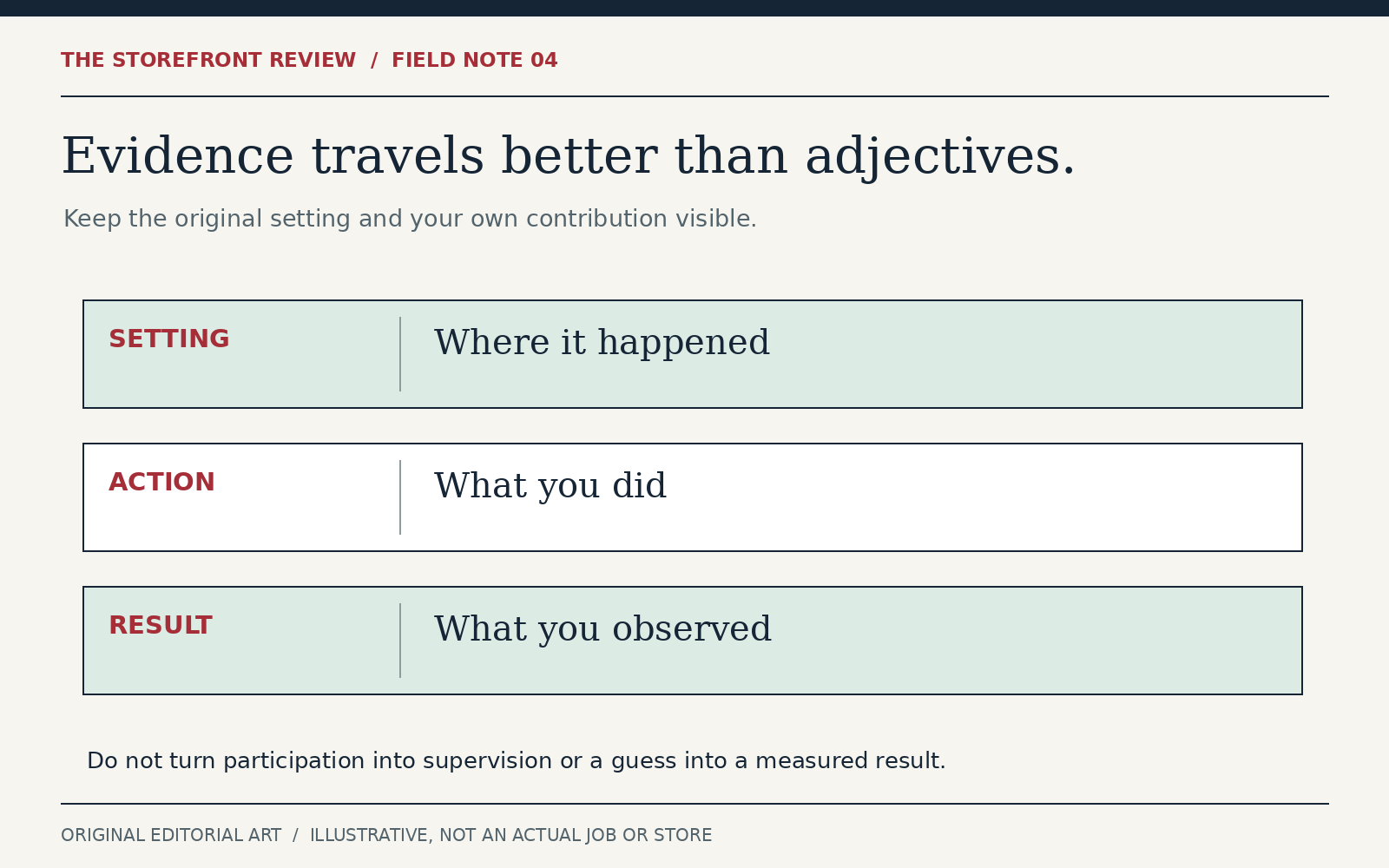
Keep each note brief at first. Name the setting, the task, your action and the observable outcome. If you cannot remember the outcome, do not invent one to complete the pattern. An honest example can end with “I flagged the discrepancy so the organizer could decide.” That explains a useful contribution without claiming responsibility for a final result you did not control. Precision often makes a modest example stronger than an inflated one.
Keep the original context intact
Evidence can come from employment, volunteering, study, clubs or other real responsibilities. Preserve its original context when you describe it. A class project is a class project. An occasional family task is not a formal position. A volunteer role should not be presented as paid work, and helping a friend should not become a fictional business relationship. These distinctions help the reader understand both the value and the limits of the experience.
Consider a fictional applicant who arranged materials for a school event. The relevant evidence might be checking quantities against a list, identifying a missing item and notifying the event lead. Calling this “managed retail inventory operations” would change the story. A better account makes the action visible in ordinary language. The transferable behavior can stand on its own without borrowing a title or level of authority the applicant never held.
Separate your contribution from the team’s
Team outcomes are often the easiest to remember and the hardest to attribute accurately. For each example, identify what you personally did, what others did and what was decided collectively. You can take appropriate credit without making yourself the sole cause of success. If you prepared a checklist that the team used, say that. If another person assigned the work or approved a change, keep that part of the story clear.
This distinction also improves interview preparation. A follow-up question may ask why you chose an action or how you knew a task was complete. You can answer confidently when the example is actually yours. If the story depends on decisions you only heard about, choose a narrower part you directly observed. The goal is not to eliminate collaboration from your account. It is to make collaboration understandable rather than using “we” to conceal an uncertain contribution.
Record evidence of learning, not just success
Useful examples do not all end in a dramatic win. Think of a time you received a correction, asked for instruction or changed your approach after discovering an error. Describe the issue without blaming another person or revealing private information. Explain what you changed and what you learned about checking your work or seeking help. Keep the lesson connected to an observable action.
A fictional example might involve misreading an event supply list, checking the discrepancy with the organizer and then marking the revised list so the error was not repeated. The applicant need not pretend that the original mistake was clever. The value lies in recognizing the limit, communicating it and making a practical correction. This is an evidence-building exercise, not a suggestion that you should disclose unrelated or sensitive incidents in an application.
Match each example to the actual question
Read the application prompt before selecting an example. A question about experience is different from one about availability or a qualification. Do not answer the question you wish had been asked. If the field asks for a factual date or credential, supply the accurate fact through the employer’s process; a story about enthusiasm does not replace it. If the prompt invites a description, choose the example that best addresses its object.
Use the job description to prioritize, not to rewrite your history. An example may show attention to detail without proving experience in a retailer’s specific system. State the transferable behavior and leave the system claim out. If a responsibility has no clear match in your bank, note what you would need to learn. The employer can assess a truthful gap. It cannot fairly assess evidence that has been adjusted until it no longer reflects reality.
Add measurements only when you can support them
Numbers can make an example concrete, but invented precision weakens it. Use quantities, dates or durations you know or can verify from your own records. If you remember the general scale but not an exact number, a truthful qualitative description is better than a guessed metric. Do not claim a percentage improvement because the sentence looks stronger with one. Explain what changed and how you observed it.
For instance, “checked each bag against the packing list before the event” describes a repeatable action. “Improved fulfillment accuracy by forty percent” requires an actual baseline, measurement and connection to your work. If those records do not exist, the larger claim is not available. An application for an entry-level role does not require turning every ordinary task into a business case. It requires enough clear information to understand what you have actually done.
Remove private information before reusing a story
An evidence bank is private preparation, but the examples selected for an application should still avoid unnecessary personal details about other people. Replace names with roles when the identity is irrelevant. Do not include customer records, confidential employer data, private health information or screenshots of internal conversations. You can explain your behavior without exposing someone else’s circumstances.
If a story cannot be told usefully without revealing restricted information, choose a different example. This is especially important when using a writing tool to help edit your wording. Give it only the nonsensitive facts needed for the editing task, and verify that the output has not added achievements or intentions you did not supply. A smoother sentence is not an improvement if it quietly changes who did the work or what happened.
Make a small, reusable selection
You do not need dozens of entries. A handful of distinct, well-understood examples is often more useful than a large file of overlapping claims. Give each a short descriptive label so you can find it: clarifying a request, organizing materials, correcting an error, meeting a commitment or learning a new process. These are your own categories, not an employer’s scoring system.
Before submitting, read each selected example aloud and ask whether you could explain every part in a conversation. Check dates and titles against your factual records. Remove unsupported adjectives and let the action carry the meaning. The finished evidence bank should make your application easier to write and easier to trust. It is not a script for becoming a different candidate; it is a way to make the candidate you actually are more legible.
Sources and boundaries
Official public sources checked October 15, 2026. The method, questions and explicitly fictional examples are original editorial work. Public information does not establish an individual offer, current vacancy, eligibility or hiring outcome.
- Dollar Tree official careers entrance: Official starting point and broad careers context; no specific opening, benefit eligibility or hiring outcome established.