In this article
The days before starting a role can fill with small uncertainties: where to report, whom to ask for, what to bring, and which details are actually confirmed. A short set of practical questions can prevent those uncertainties from becoming avoidable first-day problems. If you are preparing to begin a Dollar Tree associate position, use the instructions provided for your specific role and location. This guide is a conversation checklist, not a description of a company onboarding system.
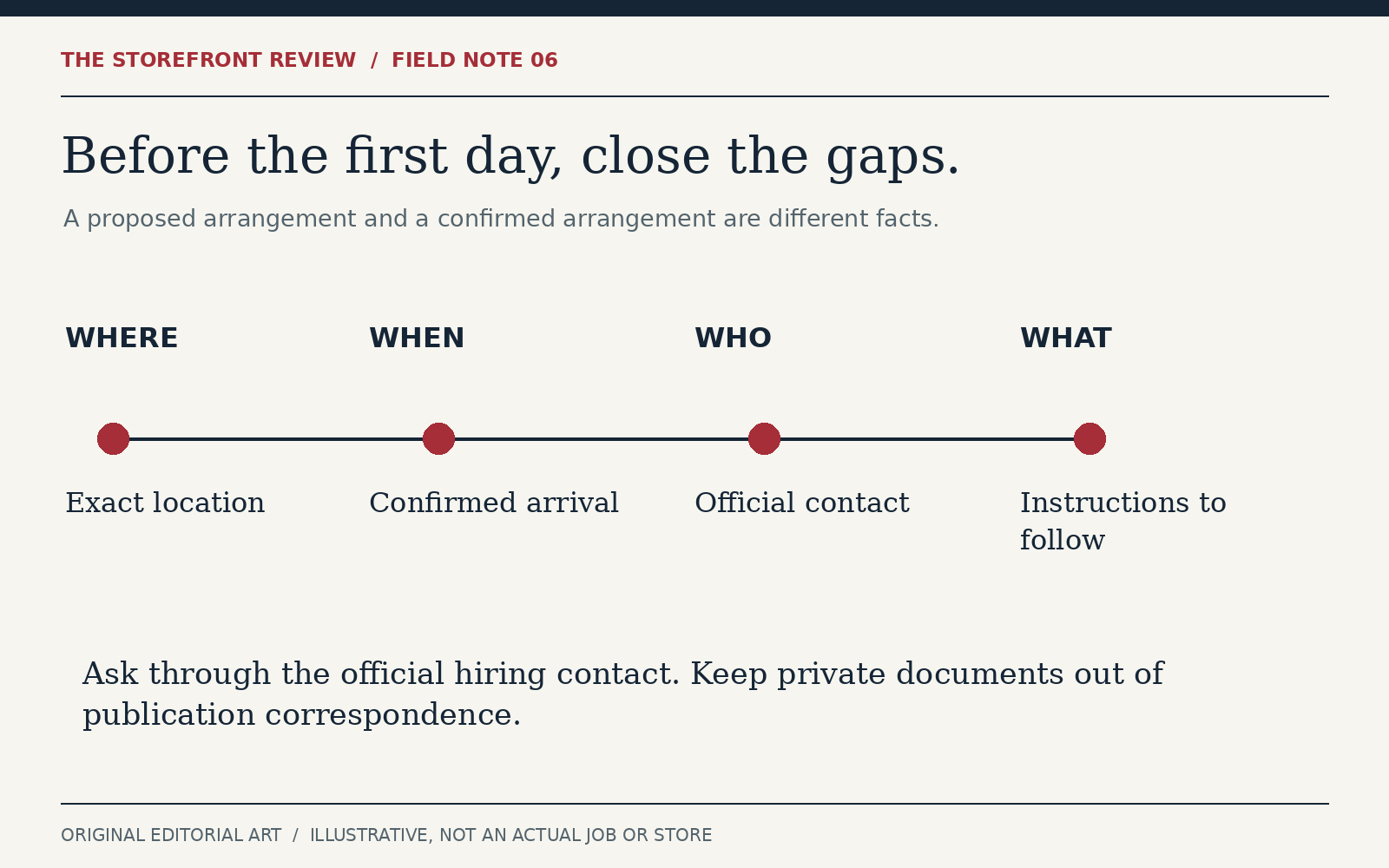
Confirm that the start information is final
Ask whether your first date, reporting time, and location are confirmed, and whether anything remains to be completed before you should arrive. An anticipated date discussed during recruitment may need a later confirmation. Keep the answer attached to your own situation rather than relying on what another applicant experienced.
Use the official Dollar Tree careers site, checked for this guide on October 15, 2026, when you need to revisit the particular listing. The public careers entry cannot confirm a personal start instruction. That information needs to come from the appropriate hiring contact.
If two messages contain different details, ask which one is current. Quote the conflicting date or location briefly so the discrepancy is easy to resolve. Avoid choosing the version that seems most plausible and hoping the difference will not matter.
Know exactly where and to whom you should report
Confirm the street address, the entrance to use, and the person or role you should ask for on arrival. A shopping-center address can cover several entrances or nearby businesses. Directions that seem obvious to someone who works there may leave a newcomer uncertain.
Ask what to do if the named contact is unavailable or the entrance is not accessible when you arrive. This is a simple contingency question, not a request for internal access procedures. You need a clear, appropriate way to make your presence known.
Check the final part of your route before the first day if possible. Account for parking or the walk from a transit stop, and use current local information for any transportation you rely on. If a travel or access issue affects your ability to meet the confirmed reporting time, raise that specific issue promptly.
Ask what to bring and how to handle private information
Request a clear list of any items or documents the employer wants you to bring. If instructions refer to a category you do not understand, ask the designated contact to clarify. Do not guess, and do not send sensitive documents to an unverified address merely because an informal message requests them.
You can ask, “Which items do I need on the first day, and who should receive any required documents?” The answer should help you distinguish things to bring in person from information that belongs in an authorized process. This guide does not provide instructions for entering personal data or using an employer system.
Keep your own preparation notes free of unnecessary sensitive details. A reminder such as “bring the documents requested in the confirmed instructions” can be sufficient. You do not need to copy identification numbers or other private information into a general checklist.
Clarify clothing and personal-item expectations
Ask what clothing and footwear requirements apply to your role and location, especially if the instructions use unfamiliar terms. If you are unsure whether an item you already own is suitable, describe it and ask. Avoid buying something solely because a discussion board says every employee must have it.
Useful questions include: “Is there anything specific I should know about footwear?” “Are there requirements I should confirm before choosing what to wear?” and “Where should I ask about an access need related to clothing or equipment?” These questions seek the applicable guidance without assuming a uniform policy.
You can also ask about practical arrangements for personal belongings, food, or water if they affect your preparation. Keep the questions concise and relevant. The objective is to arrive prepared with the right information, not to reconstruct every workplace rule before you have received the employer’s instructions.
Establish the right communication contact
Find out whom to contact if you have a question before arriving or encounter a problem that affects your attendance. Confirm the appropriate method and what information the contact needs. A phone number used during recruitment may or may not be the right channel after you start, so ask rather than assume.
Also ask how you should confirm information about the rest of the first week. This is a question about where to get reliable instructions, not an invitation to guess future working times from the first day. Keep any unconfirmed dates visibly separate in your notes.
If the contact gives you a preferred communication process, write it down in plain language. Check that you understand what to do when a message is urgent and what can wait for an ordinary conversation. Do not share internal contact details beyond the people who need them.
Understand who will guide the initial learning
Ask who will give you instructions when you begin and what the first learning priorities are expected to be. This can be as simple as, “Who should I check with before starting a task I have not been shown?” Knowing where to ask is more useful than trying to teach yourself workplace procedures from unofficial material.
You can ask whether there is anything you should review beforehand, but avoid assuming that external videos or advice describe the employer’s methods. Wait for the role-specific guidance you are given, particularly when a task involves equipment, security, or unfamiliar responsibilities.
The aim is to arrive ready to learn, not to perform expertise you do not yet have. If instructions are unclear, ask the person responsible for your training to explain or demonstrate them. This article intentionally does not teach operating procedures or advanced retail techniques.
Bring up practical needs without oversharing
Consider whether there is a specific issue that must be resolved before you arrive: an access need, a confirmed availability boundary, a communication requirement, or a practical arrangement that affects your preparation. Ask the appropriate contact how to discuss it. You do not need to distribute private personal details to every person involved in your first week.
Keep your question connected to the information or arrangement you need. “Who can I speak with privately about an access question?” may be enough to begin. If a previously discussed arrangement matters, confirm that the relevant person has the current information rather than assuming every conversation has been passed along.
Raise important issues early enough to allow a response when possible. This does not guarantee a particular arrangement; it simply gives both sides a clearer understanding of what remains unresolved before the start date.
End with a short confirmed-arrival note
Once your important questions are answered, make a compact note containing the confirmed date, time, address, reporting contact, requested items, and the communication method for a problem. Add a separate line for anything still open. This prevents an unanswered question from disappearing inside a long list of reminders.
If appropriate, send a short factual confirmation to the hiring contact: “Thank you. I have the reporting time as 9 a.m. at the location we discussed, and I will ask for the designated contact.” Use actual confirmed details, and invite correction if any part of your summary is uncertain.
Recheck the latest instructions before leaving for the first day. Preparation is complete when you know how to arrive, whom to approach, and where to get guidance. You are not expected to resolve every future question in advance; you are establishing a dependable starting point for learning the role.
Sources and boundaries
Official public sources checked October 15, 2026. The method, questions and explicitly fictional examples are original editorial work. Public information does not establish an individual offer, current vacancy, eligibility or hiring outcome.
- Dollar Tree official careers entrance: Official starting point and broad careers context; no specific opening, benefit eligibility or hiring outcome established.