In this article
A job result can look current long after the opportunity behind it changes. Titles remain in search indexes, screenshots travel without dates, and a store sign may not identify a particular requisition. For a prospective Dollar Tree associate, the practical problem is not collecting the largest number of leads. It is establishing which lead refers to the role, location and application route you actually intend to use.
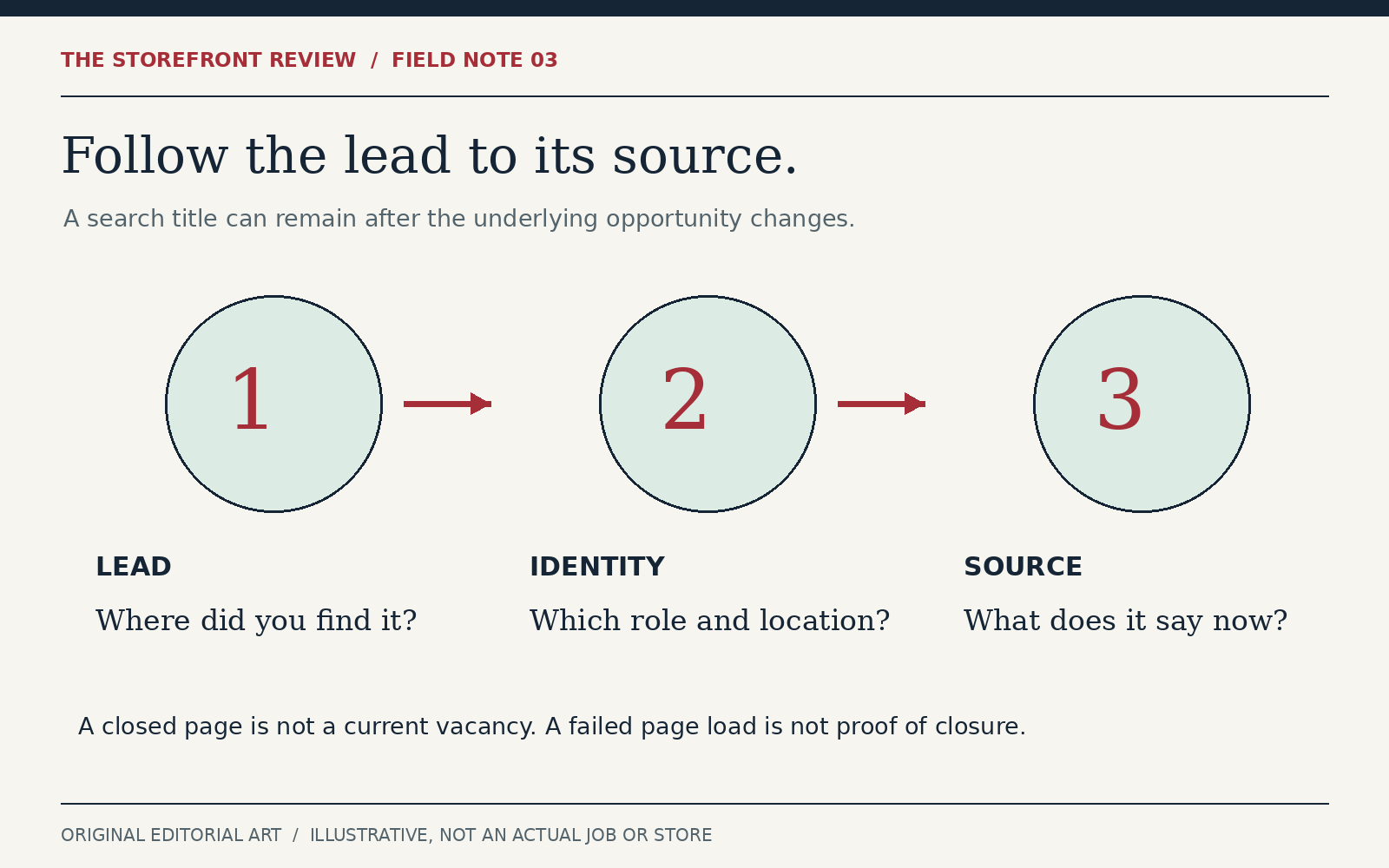
A verification trail has four parts: where the lead appeared, where the official source takes you, what that source currently says and what you still need to ask. The method below helps you keep those parts separate. It is not a live vacancy directory. This publication has no connection to an employer’s recruiting records and cannot confirm an individual application’s status.
Treat a search result as a lead
Search engines and job aggregators help you discover possible openings. Their usefulness does not make every displayed detail authoritative or current. A result may show a title, location and excerpt copied at a different time from the page you reach. Begin by recording enough of the lead to identify it, then continue to the employer’s current source. Do not submit personal information merely because a familiar company name appears in a headline.
Keep the distinction in your notes. “Found in search” is a discovery fact. “Official page currently displays an application option for this requisition” is a different observation. Neither proves that an interview will be offered or how long the opening will remain available. The aim is to improve the quality of the next step, not create certainty that no public webpage can provide.
Use the company’s own entrance
The Dollar Tree careers site is the starting point linked from the company’s corporate materials. Navigate from that verified entrance when you need to establish a route, instead of guessing the destination from a shortened link or copied logo. A recruitment website may legitimately use another service for part of its process; the important connection is whether the official source directs you there for the action you are taking.
Read the destination as it appears at the time you visit. A page title alone is not enough. Check the actual content, the named role and location, and whether the page describes an opening or tells you it is unavailable. If the page fails to load, that is a technical observation. It does not establish that the role has closed. Try the official search path again or use the employer’s documented help route without making up a conclusion.
Match identity before comparing details
Create a small identity line containing title, location and requisition identifier when one is displayed. Compare that line across the lead and the official page. A matching city is not a complete match when several stores operate nearby. A matching title is not a complete match when different locations use it. If the identifier differs, treat the entries as separate until the employer or source explains their relationship.
Suppose a fictional search result names an associate opening on East Avenue, while the official page you reach names West Avenue. Do not assume the address was corrected or the job transferred. Record the discrepancy. You can search the intended location through the official site and ask which opening is being discussed. This preserves a simple fact: a promising title does not override a mismatched destination.
Read closure language as closure language
During this publication’s source review, an official associate listing displayed that the job had been filled. It is included here only to demonstrate why a still-discoverable title is not evidence of an available position. It is not offered as a job lead, and its status may change after the review date.
When you encounter a comparable message, do not keep treating the old URL as a current opening. Return to official search and evaluate any new result on its own identity. Conversely, an empty or partially rendered search screen does not prove there are no openings anywhere. Dynamic websites can display incomplete results in some viewing conditions. Write what you observed narrowly and avoid turning a local technical problem into a company-wide statement about hiring.
Separate a sign from a specific requisition
A hiring sign gives you a reason to investigate. It may not tell you the exact role, employment status or current requirements. The official hiring FAQ directs people who see hiring signs to search for opportunities by location or title. That route lets you connect the general invitation with a specific opening before completing an application.
If you speak with a store representative, make the question concrete: which role and location should you look for in the official search, and is there an identifier that distinguishes it? You are asking for a reliable connection, not requesting an informal promise. Record the answer privately. Do not assume that a brief conversation or a sign means an application has been submitted or that a position has been reserved.
Check the request as well as the sender
A message about a job deserves scrutiny even if the name looks familiar. Ask whether the request fits the stage of the process and the verified role. Be cautious about unexpected demands for payment, credentials or private identity information through an unverified channel. Do not forward those records to an independent publication to ask whether they look legitimate. Use an official contact reached independently from the company’s public site to clarify a concerning request.
This is a narrow verification practice, not a claim that every unusual message is fraudulent. Mistakes, changed contacts and legitimate third-party services can occur. The safe habit is to establish the connection before supplying information. Keep your notes factual: the channel, what was requested, the claimed role and the question you need answered. Avoid publicly posting someone’s personal contact information while seeking help.
Keep a useful application record
Once you choose a verified opening, keep a private record of what you submitted and when. Include the role identity and any confirmation you receive. The record helps you distinguish two applications and gives a future follow-up enough context. It does not need to be elaborate, and it should not become a collection of unnecessary sensitive information. Store it somewhere you control and use ordinary care with shared devices.
A confirmation of receipt is different from selection, an interview invitation or an offer. Name each event accurately in your record. If a message announces a next step, preserve that instruction and its source. If there is no confirmed next step, write “not yet confirmed” rather than inventing a deadline from another person’s experience. A clear record reduces the temptation to submit repeated applications simply because you cannot remember what already happened.
Know when verification is enough
You have enough information to consider applying when the role identity and official route are clear and you understand any material questions that remain. You do not need to prove that a job will stay open indefinitely. You do need to avoid treating a stale result, a mismatched location or an unverified request as established fact. Continue the trail only as far as the decision requires.
If you cannot verify the lead, keep it separate from confirmed opportunities and move on to sources you can establish. If an official page is unavailable, describe that limitation plainly instead of filling it with a guess. Good verification is not a dramatic investigation. It is the quiet discipline of connecting a lead to its source and refusing to let a familiar name substitute for the missing connection.
Sources and boundaries
Official public sources checked October 15, 2026. The method, questions and explicitly fictional examples are original editorial work. Public information does not establish an individual offer, current vacancy, eligibility or hiring outcome.
- Dollar Tree official careers entrance: Official starting point and broad careers context; no specific opening, benefit eligibility or hiring outcome established.
- Official listing observed as filled: Reviewed as an example of a discoverable title whose underlying page says the opening has been filled; not a current job lead.
- Dollar Tree hiring frequently asked questions: Official application route and variable position-specific process. This publication does not provide candidate or employee account instructions.