In this article
A title is a label. A job description is a set of statements that need to be read together. When you are considering a Dollar Tree associate opening, it is easy to recognize a familiar store and fill the remaining gaps from shopping there. You have seen the public floor, perhaps a checkout line and a busy delivery day. You have not necessarily seen how that specific opening is defined, which responsibilities it includes, or what the hiring team currently needs.
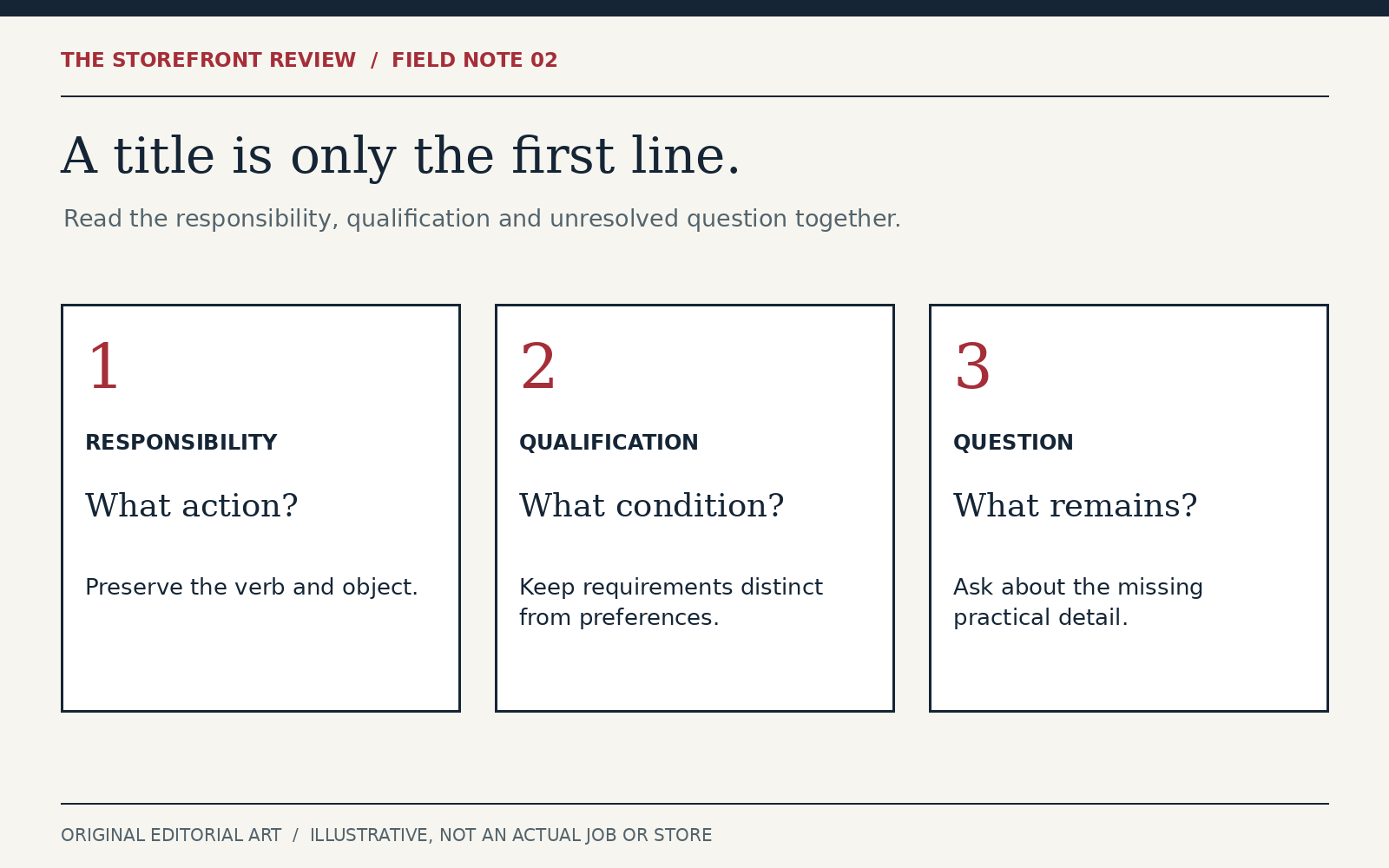
This article offers a description-to-question worksheet. Its purpose is to turn the actual posting into a readable account of responsibilities, evidence and uncertainties. It does not supply a standard company job description or predict how a store will assign work. Keep the official careers listing open beside your notes so that each observation can be traced back to its source.
Give the description an identity
At the top of the worksheet, record the exact title, location, requisition identifier if available and review date. Include the source address. If you downloaded a copy for your private application records, distinguish its download date from any date the employer displays. Those dates do different jobs. A recent download does not prove that an old vacancy remains open, and an older posting date does not by itself prove that an opportunity has closed.
Check that the body belongs to the opening you intended to read. Search results, browser tabs and copied notes can become mixed when several stores have similar titles. If a detail disagrees with the heading, preserve both and investigate rather than choosing the one you prefer. A description without an identifiable location may still be a useful lead, but it is not yet a complete basis for evaluating your trip or the particular opening.
Extract the verbs and their objects
Read one paragraph at a time and identify the action and what it acts on. “Assist” by itself tells you little. Assist a customer, a manager or an inventory process are different responsibilities. Write a short paraphrase that retains the object, any named standard and any condition attached to the action. Avoid replacing every varied responsibility with the vague phrase “help out.”
Then ask what the sentence does not establish. A responsibility can be part of the job without telling you how often it occurs, what training precedes it or which decisions you may make independently. Your worksheet can therefore have two entries for the same sentence: the responsibility described, and the practical question it raises. This is not nitpicking. It is a way to arrive at an interview with questions that arise from the employer’s words rather than assumptions about retail generally.
Preserve the strength of the language
Pay attention to words that establish a requirement, preference, possibility or example. If a description says experience is preferred, do not rewrite that as an absolute requirement in your own notes. If it describes a requirement, do not dismiss it because another applicant said they were hired without discussing it. The relevant source is the particular posting and the employer’s clarification of that posting.
A useful private annotation is to write the sentence’s function beside it: required, preferred, responsibility, context or unclear. These categories are your reading aids, not an official hiring classification. When the wording resists a confident category, retain the ambiguity. Ask which qualifications are essential for the opening and how the employer assesses them. Do not treat the absence of a detail as proof that there is no condition behind it.
Read physical and practical requirements literally
If the description contains physical or practical requirements, read the whole passage rather than a detached number or phrase. Note any conditions and the relationship to the role. Avoid deciding from a shopping visit how the work must be arranged. You can ask the official hiring contact to explain the essential functions and the process for discussing an accommodation or access need, without sending private medical information to this publication.
The reading task here is not a medical or legal assessment. It is to identify what the employer actually wrote, which part you understand and where clarification is needed. A useful question names the requirement rather than making a broad statement about your body or health. If the answer affects your ability to consider the role, obtain appropriate guidance through the employer’s designated process or a qualified adviser you choose.
Distinguish the role from the organization’s message
Careers pages often include broad messages about opportunity, culture and development. Those materials can help you understand what the employer emphasizes, but they do not automatically become terms of a particular opening. Keep organization-level claims in a separate section from role-level facts. A general story about advancement does not establish a promotion timetable for a new hire. A benefits heading does not determine your individual eligibility.
The official careers homepage itself qualifies benefit information by reference to eligibility and plan documents. That is a reminder to ask which information applies to the specific role under consideration. Do not try to resolve eligibility by combining attractive fragments from different pages. If a benefit is central to your decision, request the applicable information and read its conditions before treating it as confirmed.
Match responsibilities to evidence you actually have
Beside each understood responsibility, write one example from your experience that shows a related behavior. The fit may be direct, partial or not yet established. Those are all useful answers. A partial fit can become a clear explanation of what you have done and what you would need to learn. An empty evidence box is a preparation prompt, not an invitation to invent a qualification.
Consider a fictional applicant who helped organize a neighborhood event. They can describe checking supplies against a list and alerting the organizer to missing items. They should not call that experience store inventory management or imply training on a retailer’s systems. The strongest match explains the transferable action without changing the original context. If you struggle to explain the connection in an ordinary sentence, the example may be less relevant than another one you have overlooked.
Turn broad phrases into bounded questions
A question should reduce one important uncertainty. “What is the job like?” can be a reasonable opener, but it is difficult to use as a decision record. Follow it with a question tied to a responsibility: what does the store expect a new person to learn first, which tasks are commonly combined in this opening, or whom should a new hire ask when priorities conflict? These are examples of inquiry, not claims about company procedure.
Choose questions that matter for your application. You do not need to interrogate every line at once. If a responsibility seems unfamiliar but learnable, ask about the initial instruction. If the availability language is unclear and you have a fixed constraint, ask about that before making a promise. The worksheet should make the conversation shorter and more precise, not turn it into a reading examination for the hiring team.
Keep an updated version of your understanding
After a conversation, add the answer, its source and the date beside the question. Distinguish a direct clarification from your interpretation. If the answer changes how you understand the role, revise the summary rather than leaving two incompatible versions in your notes. If a subsequent written offer differs, return to the discrepancy before deciding. Do not quietly combine the most favorable parts of different accounts.
Finish with a short statement in your own words: this is the role and location I am considering; these are the responsibilities I can describe; this is the evidence I can offer; these are the questions that remain. Read it against the source one more time. A description has done its work when it gives you an honest basis for the next step, even if that next step is to ask a question or choose a different opening.
Sources and boundaries
Official public sources checked October 15, 2026. The method, questions and explicitly fictional examples are original editorial work. Public information does not establish an individual offer, current vacancy, eligibility or hiring outcome.
- Dollar Tree official careers entrance: Official starting point and broad careers context; no specific opening, benefit eligibility or hiring outcome established.