In this article
An offer deserves a slower read than a recruiting conversation. You are trying to understand what is being offered, which details remain conditional, and what you still need to ask. If you are comparing a Dollar Tree associate opportunity with another opening, work from the information supplied for each specific role. Keep written facts, spoken explanations, and your own assumptions separate so that an attractive possibility does not quietly become a promised term.
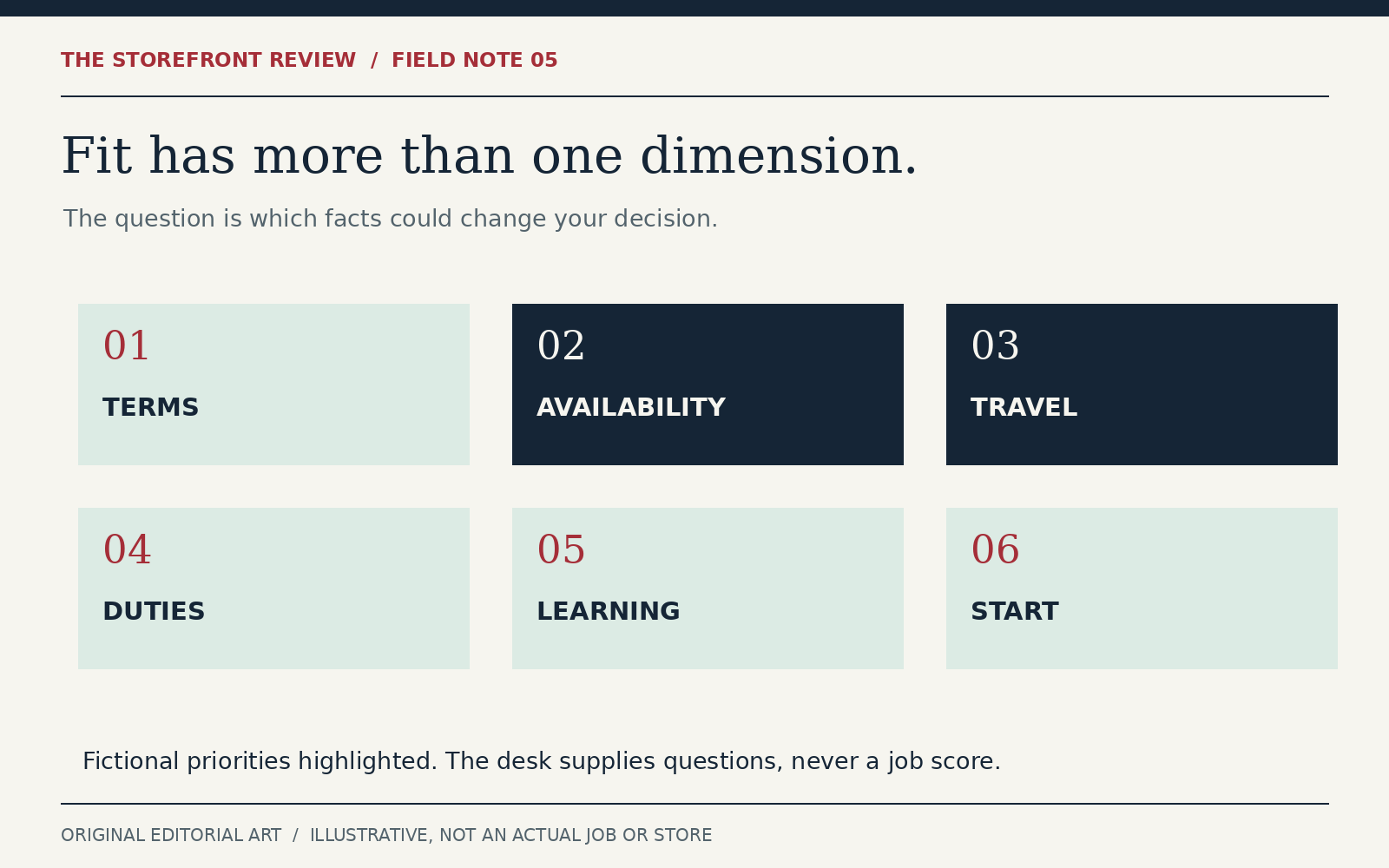
Identify the role the document describes
Begin with the basics: position title, work location, employment status as stated, anticipated start information, and the contact associated with the offer. Compare these details with the opening you discussed. A small difference in title or address may be harmless, but it is worth clarifying before you rely on an assumption.
The official Dollar Tree careers entry, checked on October 15, 2026, provides a starting point for checking the relevant listing. Public information should be read alongside the actual materials provided to you. This article cannot establish the terms of an individual offer or confirm that an opening is currently available.
If you received only a verbal explanation, ask what written information can be provided for review. Keep the request practical: “Could you send the details for this specific position so I can make sure I understand them correctly?”
Separate stated facts from unresolved details
Make three small lists: written information, spoken information, and open questions. Record where each detail came from. If a hiring contact described a likely arrangement but the written material says something broader, preserve both statements accurately rather than combining them into the answer you prefer.
Pay attention to qualifying words. “Expected,” “may,” “subject to,” and “eligible” can leave important details unresolved. You do not have to interpret their legal effect to recognize that a question remains. Ask what the wording means in your situation and which document or contact can provide clarification.
For example, an expected start date may depend on steps that have not been completed. Ask what remains and how confirmation will be communicated. Do not treat an estimate as a final instruction to arrive, and do not assume that silence removes a condition mentioned in the materials.
Read compensation details without filling gaps
If a rate is stated, note the amount, the unit used, the role it applies to, and any explanation provided. Check that you understand whether the figure describes an hourly rate or something else. Ask about a discrepancy between written information and what you were told rather than choosing one version yourself.
Keep the rate separate from the amount of work you may receive. A stated hourly figure does not, by itself, establish a particular number of hours. Similarly, an example of possible earnings may depend on assumptions that do not describe your situation. Ask which parts are confirmed and which are illustrative.
This is a reading method, not wage-law guidance or a prediction of take-home income. If the documents leave an important compensation question unanswered, seek a direct explanation from the appropriate employer contact. Avoid using general online claims to settle the terms of your individual offer.
Ask about time commitments and location
Review the availability you previously supplied and identify any apparent mismatch. Ask about expectations that matter to your ability to accept: required availability, the work location, the anticipated amount of work if it is discussed, and how information about work times will be communicated. Do not assume that an interview conversation settled details it never explicitly addressed.
If a contact describes a usual pattern, ask whether that description is an expectation, an estimate, or a commitment included in the offer. The answer may still involve uncertainty. Your task is to understand it, rather than press every variable into a false guarantee.
Location also matters. If the offer or conversation mentions another site, clarify what travel would be required and when. A position that fits your availability at one address may be different at another. Revisit your practical transportation check when any relevant detail changes.
Treat benefits information as a separate review
Broad recruiting material may describe programs, while your eligibility can depend on details specific to your employment situation and the applicable terms. Ask what information applies to this particular offer and where you can review the relevant requirements. Do not assume that a program mentioned on a general page is included for every applicant.
Useful questions include: “Which benefits information applies to this position?” “Are there eligibility conditions or waiting periods I should review?” and “Who can answer a question about the materials?” These questions seek clarity without promising that any particular benefit will be available.
Keep a note of any answer you still need before deciding. If the response refers you to another document, read that document rather than relying on a short summary alone. Benefits can be complex; this article does not compare plan suitability or advise you on financial or health coverage choices.
Compare offers using the same categories
When considering two opportunities, use matching headings: role, location, stated compensation, time expectations, start conditions, relevant benefits information, and response deadline. Put “not confirmed” wherever information is missing. An empty field should not silently become the most favorable answer.
You may discover that the apparent difference between offers is really a difference in how much information you have. One employer may have provided a written rate and another only a preliminary discussion. One may have clarified the work location while another has not. Resolve those gaps before describing the choices as directly comparable.
Add a short personal note about practical fit, such as a confirmed commute limitation or an existing commitment. Keep that note separate from employer-provided facts. No single score can decide the right choice for every person, and this method does not recommend accepting an offer based on a financial calculation.
Send a focused clarification request
Group related questions into a short message so the recipient can answer them clearly. Identify the role and location, name the detail you are checking, and explain any relevant discrepancy without accusing anyone of misleading you. “The written material lists one location, and we discussed another. Which location applies to this offer?” is easier to resolve than a vague statement that the offer is confusing.
Prioritize questions that affect whether you can accept. Save minor curiosities for later if they do not change the decision. If the response introduces a new condition, record it and ask what it changes.
Check any stated response deadline. If you need more time to review unanswered questions, ask whether an extension is possible and specify the time you are requesting. Do not assume an extension has been granted until you receive a clear response.
Make your response match your decision
Before answering, reread the current version of the offer and the clarifications you received. Make sure your understanding does not rely on an outdated conversation or an earlier document. Keep copies of the materials for your own reference, along with the date and substance of important exchanges.
If you are still deciding, say so and identify the unresolved question. If you choose to accept or decline, follow the instructions supplied for that particular offer and use wording that accurately reflects your decision. Ask for clarification when you do not understand what a requested acknowledgment would communicate.
An informed response does not require certainty about every future experience at work. It requires a clear understanding of the terms presented, the uncertainties that remain, and the practical commitments you can make. That is the standard this review is designed to support.
Sources and boundaries
Official public sources checked October 15, 2026. The method, questions and explicitly fictional examples are original editorial work. Public information does not establish an individual offer, current vacancy, eligibility or hiring outcome.
- Dollar Tree official careers entrance: Official starting point and broad careers context; no specific opening, benefit eligibility or hiring outcome established.